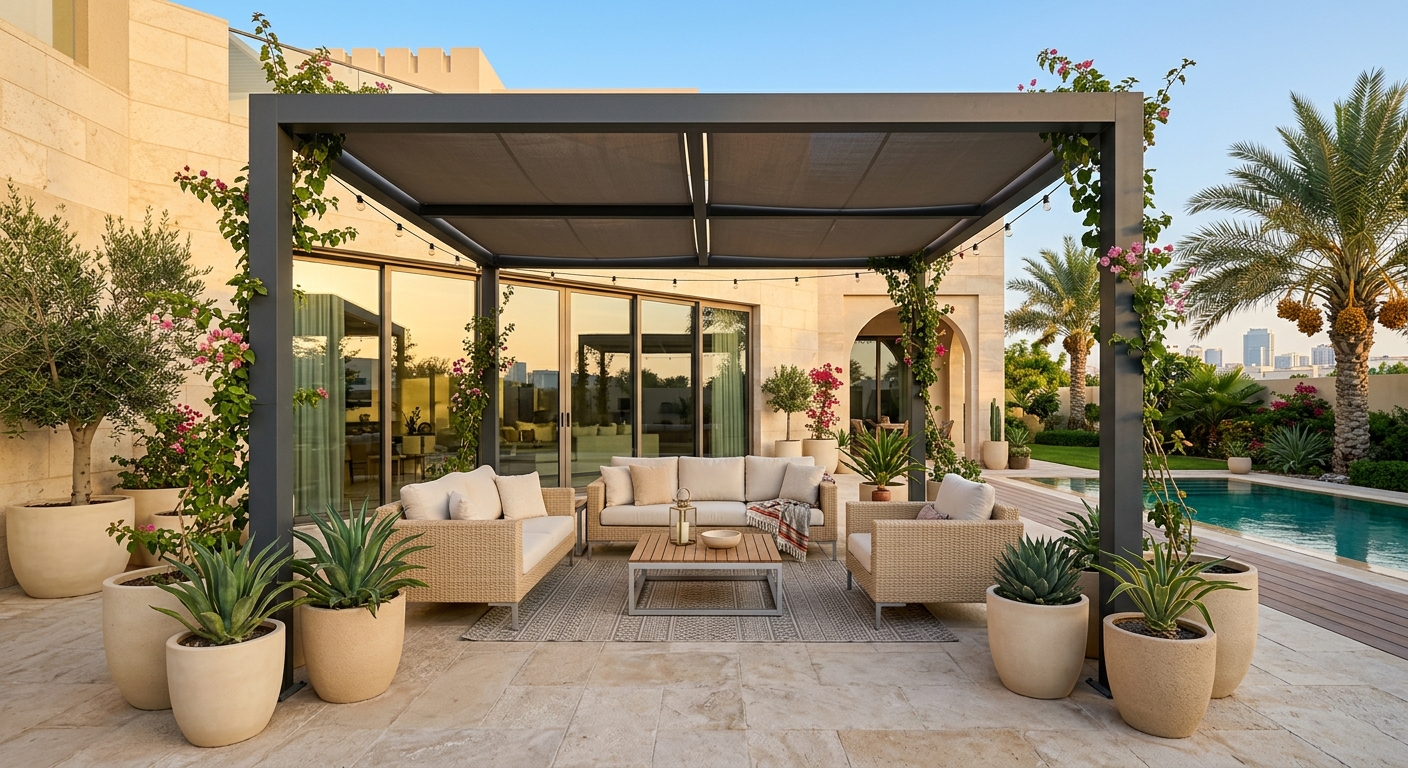
Stylish Outdoor Decor for Your Home
Selecting stylish outdoor decor for your home in Bahrain usually fails when buyers prioritize aesthetics over material durability. The reality of 45°C+ summer heat, aggressive coastal humidity, and seasonal Shamal dust storms will destroy untreated wood, melt standard plastics, and fade vibrant fabrics within a single season. If you do not design for the climate first, you will replace your entire setup by October.
This guide evaluates exterior pieces based on strict climate-resilience criteria. We explicitly excluded standard PVC, untreated softwoods, and dark metals due to their 100% failure rates in the Gulf. Whether you have a compact 10-square-meter balcony in Juffair or a sprawling villa garden in Saar, this categorical list identifies exactly which materials will survive the local climate.
How This List Was Created: The 3-Point Bahrain Climate Test
Every piece of stylish outdoor decor for your home must pass three specific environmental thresholds to avoid rapid degradation. Ignoring these mechanisms guarantees premature failure and wasted money.
UV-Resistance and Fade-Proof Ratings (Minimum 1,000 Hours)
Ultraviolet radiation in the Middle East actively breaks down polymer chains in synthetic materials and bleaches fabric dyes. Without a certified UV-resistance rating of at least 1,000 hours, plastic becomes brittle and snaps under human weight, while dark fabrics turn a sickly gray. We only include materials engineered with UV inhibitors mixed directly into the base compound, rather than applied as a topical spray that washes off in the winter rain.
Dust-Repellent and Washable Surfaces for Post-Shamal Cleanup
Bahrain's frequent dust storms deposit fine, abrasive silt that embeds permanently into porous materials. Decor with deep, unsealed textures or non-removable fabric covers becomes impossible to clean and degrades visually within weeks. Every item on this list features either a non-porous surface that can be pressure-washed or removable components that survive heavy mechanical laundering.
Wind-Weight Stability for Unpredictable Coastal Gusts
Properties in Amwaj, Diyar Al Muharraq, and high-rise balconies in Seef experience sudden, severe wind tunneling. Lightweight resin chairs or unanchored umbrellas act as sails, causing property damage and severe safety hazards. The selections below either possess sufficient dead weight to remain stationary in 60 km/h gusts or feature flow-through designs that prevent wind capture.
Essential Stylish Outdoor Decor for Your Home: Categorized by Function
This unranked list categorizes the specific items that survive prolonged exposure testing. We detail exactly how they function in extreme heat and the specific scenarios where they perform best.
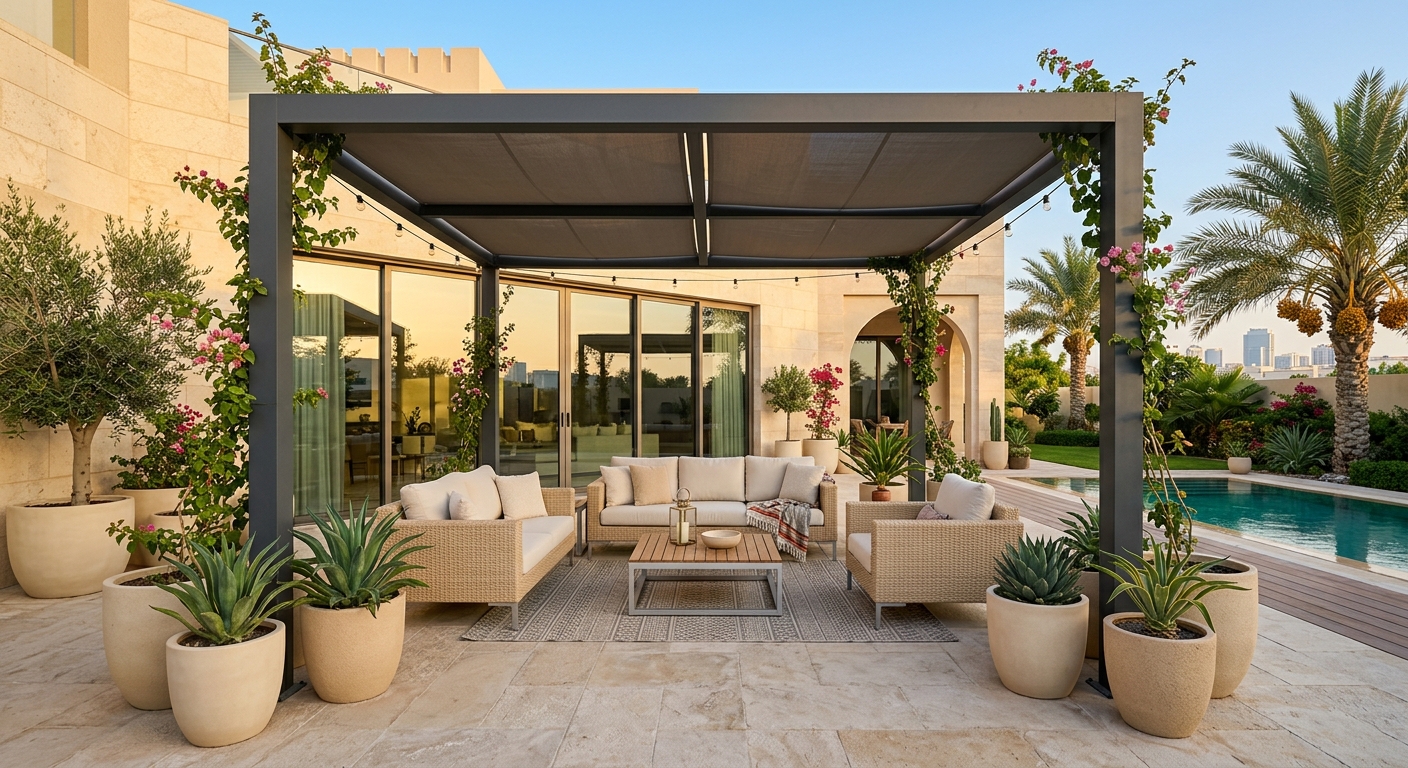
1. Powder-Coated Aluminum Pergolas (Best for Year-Round Sun Protection and ROI)
Aluminum does not rust when exposed to Bahrain's 80%+ summer humidity, and the baked-on powder coating prevents the oxidation pitting that destroys raw metals. Unlike fabric shade sails that tear in high winds, louvered aluminum pergolas allow you to mechanically angle the roof to block direct sun while venting trapped hot air upward.
- When it makes sense: Unshaded south-facing terraces in Saar or Hamala where you need a permanent, temperature-controlled dining zone.
- When it does NOT make sense: Rented properties where the landlord prohibits drilling into the exterior slab.
- What you give up: Flexibility. Once bolted down, it cannot be easily reconfigured.
- Cost expectation: BD 600 to BD 1,500+ depending on motorization and square meterage.
2. High-Density Polyethylene (HDPE) Wicker Majlis Sets (Best for Large Evening Gatherings)
HDPE is a synthetic resin that expands and contracts with temperature swings without snapping, unlike standard PVC wicker which turns brittle and shatters. When woven over a rust-proof aluminum frame, it provides the visual warmth of traditional rattan while easily surviving pressure washing after a dust storm.
- When it makes sense: Large villa gardens requiring seating for 8+ people during winter evening gatherings.
- When it does NOT make sense: Tight apartment balconies where the deep seating profiles block access to the doors.
- What you give up: Cool seating temperatures in direct August sun. Even UV-treated HDPE will retain heat if not placed under a shade structure.
- Cost expectation: BD 250 to BD 800 for a complete sectional set.
3. Solar-Powered Brass Pathway Lanterns (Best for Low-Maintenance Ambient Lighting)
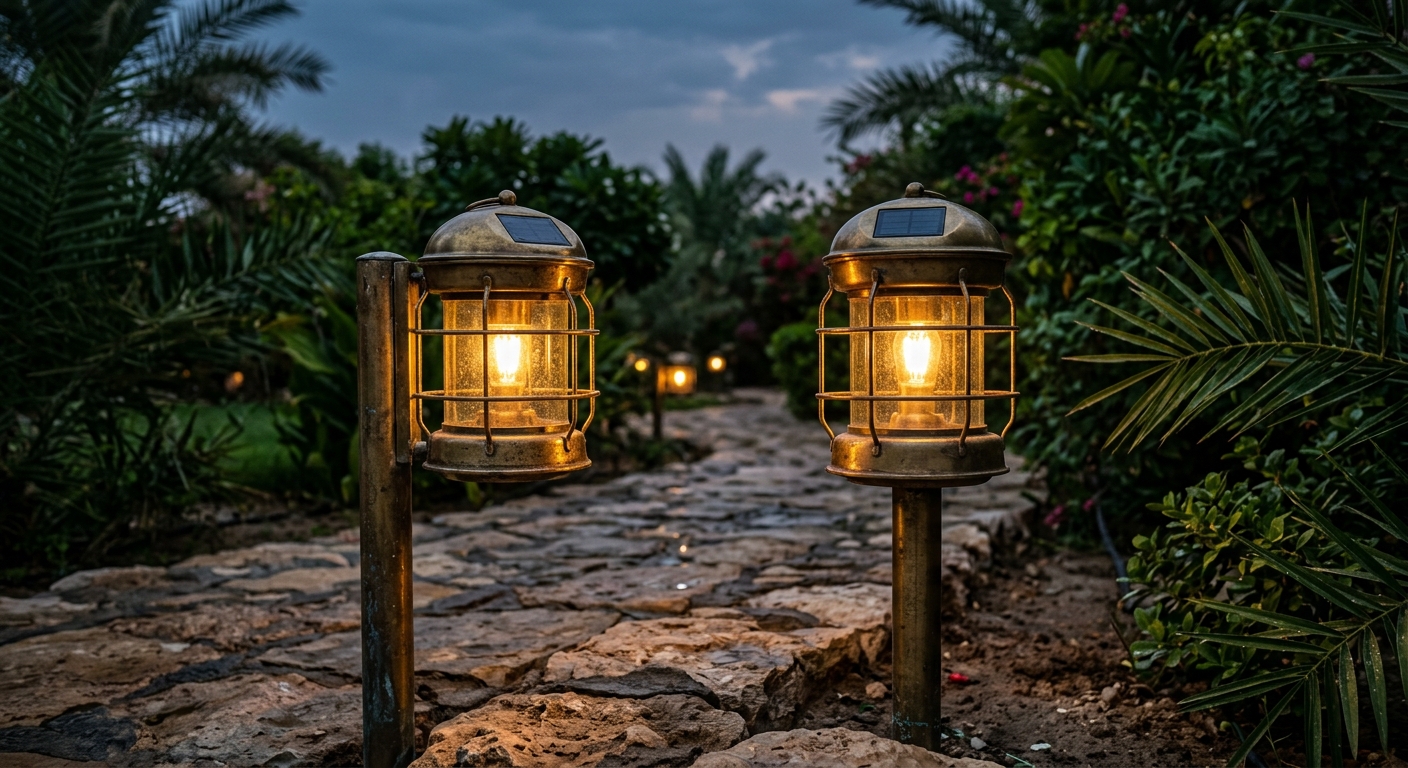
Brass reacts to salty coastal air by developing a protective patina rather than structural rust, making it superior to painted steel. Integrating solar panels eliminates the need to dig deep trenches through existing landscaping for electrical conduit, which is a major bottleneck in older Riffa homes.
- When it makes sense: Illuminating walkways or garden perimeters where hardwiring is prohibitively expensive or destructive.
- When it does NOT make sense: Areas heavily shaded by mature trees or adjacent high-rise walls that block the 6-8 hours of direct sunlight needed for a full charge.
- What you give up: Consistent brightness. Output drops significantly during dusty weeks if you fail to wipe the solar panels clean.
- Cost expectation: BD 15 to BD 35 per fixture.
4. Laser-Cut Corten Steel Privacy Screens (Best for High-Density Neighborhoods)
Corten steel is engineered to develop a stable, oxidized rust layer on its surface that acts as a shield, preventing deeper corrosion from humidity. These heavy panels block sightlines from neighboring properties while the laser-cut geometric patterns allow wind to pass through, preventing the structure from acting as a sail.
- When it makes sense: Ground-floor patios in dense areas like Juffair or Adliya where you need to block street-level visibility.
- When it does NOT make sense: Installed directly over light-colored, porous stone tiles.
- What you give up: Floor cleanliness. The initial oxidation process will bleed rust-colored runoff onto the floor during the first few rainstorms unless you apply a clear sealant.
- Cost expectation: BD 80 to BD 150 per panel.
5. Glazed Ceramic Planters in Light Tones (Best for Heat-Reflective Root Protection)
Light-colored exterior glazes reflect thermal radiation, keeping the internal soil temperatures below the 40°C threshold where plant root systems begin to cook. The non-porous glaze also stops irrigation water from evaporating through the sides of the pot, reducing your watering frequency by up to 30% compared to raw terracotta.
- When it makes sense: Housing bougainvillea or desert roses on exposed, sun-baked terraces.
- When it does NOT make sense: Balconies with strict weight limits.
- What you give up: Mobility. A large ceramic planter filled with wet soil can weigh over 80kg and requires heavy-duty casters to move.
- Cost expectation: BD 20 to BD 60 depending on diameter.
6. Solution-Dyed Acrylic Outdoor Rugs (Best for Barefoot Comfort on 50°C Tiles)
In solution-dyed acrylic, the color pigments are mixed into the liquid polymer before the fiber is extruded, meaning the color goes all the way through the thread. This mechanism prevents the rug from fading in direct sunlight and provides a thermal break, preventing severe burns to bare feet on dark patio tiles during summer afternoons.
- When it makes sense: Creating a defined, barefoot-friendly lounge zone on a concrete or dark-tiled balcony.
- When it does NOT make sense: Placed over wooden decking without a breathable pad.
- What you give up: Zero maintenance. You must lift the rug after heavy winter rains, or it will trap moisture and breed mildew underneath.
- Cost expectation: BD 40 to BD 120.
7. Concrete Fire Pits with Teak Table Covers (Best for Dual-Use Winter/Summer Functionality)
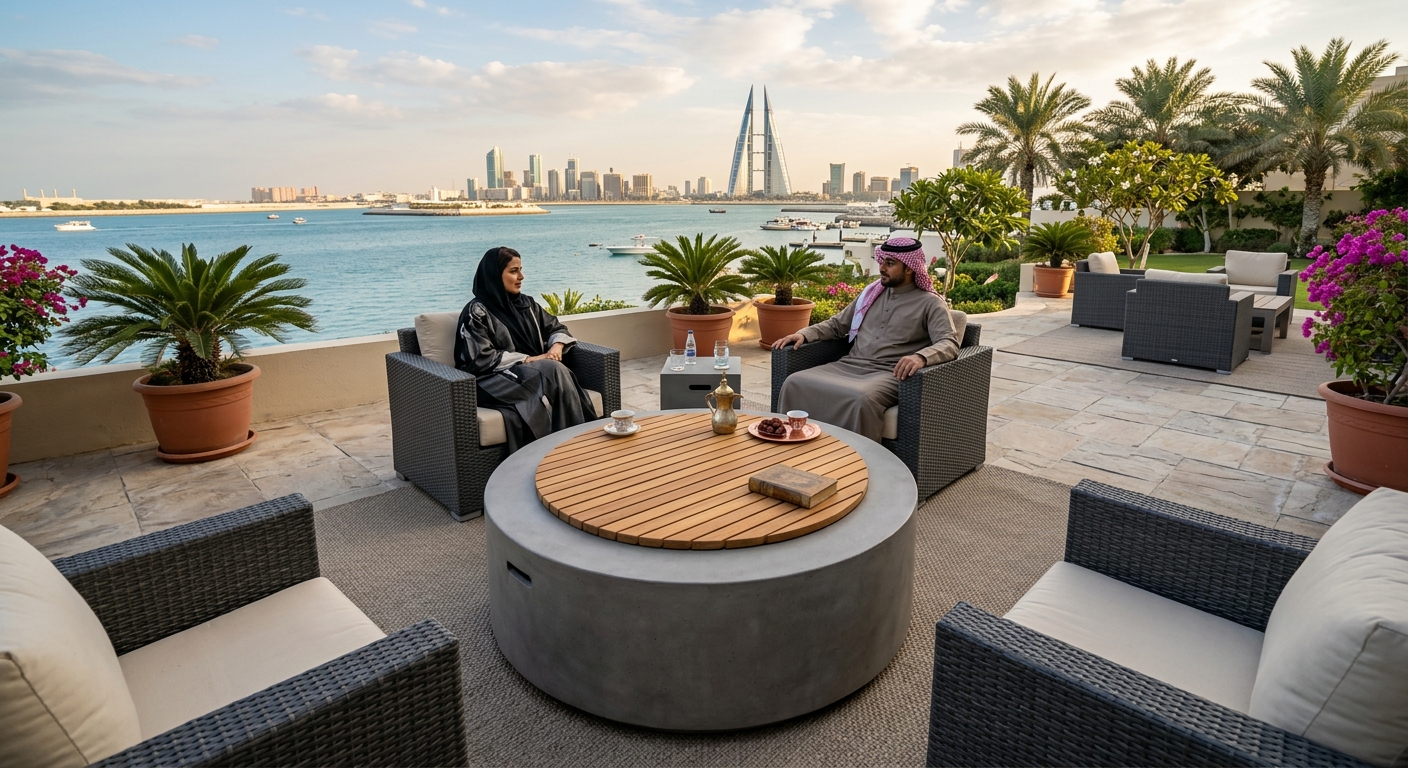
Glass-fiber reinforced concrete survives extreme thermal shock—the rapid transition from a 300°C fire to a cold winter night—without cracking. Purchasing a model with a heavy teak cover converts the fire pit into a functional coffee table for the eight months of the year when a fire is unnecessary.
- When it makes sense: Central focal points for winter entertaining in large courtyards.
- When it does NOT make sense: Properties without a dedicated outdoor gas line, forcing you to constantly drag heavy 20kg propane tanks from the local petrol station.
- What you give up: Ease of relocation. These units are exceptionally heavy and usually become permanent fixtures once placed.
- Cost expectation: BD 150 to BD 400.
What Didn't Make the Cut: Materials That Fail in the Gulf Climate
Many international brands market products that look stunning in European catalogs but disintegrate rapidly in the Middle East. Avoid incorporating these materials when selecting stylish outdoor decor for your home.
Untreated Pine and Softwoods (High Risk of Warping and Termite Damage)
Softwoods lack the dense grain structure and natural oils required to resist moisture fluctuations. In Bahrain, the rapid shift from dry 45°C days to 85% humidity nights causes pine to warp, splinter, and pull out its own screws within six months. Furthermore, untreated wood resting on soil is an immediate target for subterranean termites common in older residential blocks.
Dark-Colored Heavy Iron Seating (Severe Skin Burn Hazards in Direct August Sun)
Cast iron absorbs and retains thermal mass at an alarming rate. A black iron chair left in the Bahrain sun will reach surface temperatures exceeding 65°C, causing instant first-degree burns to exposed skin. Even with thick cushions, the exposed armrests remain a severe hazard for children and pets.
Standard Polyvinyl Chloride (PVC) Decor (Prone to Melting and Chemical Off-gassing)
Cheap plastic furniture is manufactured using standard PVC, which lacks the thermal stability to survive ambient temperatures above 40°C. Under the local sun, these chairs physically warp, the legs bow outward under human weight, and the plastic emits toxic volatile organic compounds (VOCs) as it bakes.
How to Use This List: Matching Decor to Your Specific Bahrain Property Type
Implementing stylish outdoor decor for your home requires scaling the materials to fit your spatial constraints and local wind conditions.
Apartment Balconies in Seef or Amwaj: Prioritizing Vertical Space and Wind Resistance
High-rise coastal balconies experience severe wind sheer. Avoid lightweight aluminum chairs or tall, narrow planters that will tip over. Focus on heavy, low-profile concrete planters and secure a solution-dyed acrylic rug to the floor using heavy, low-slung seating. Maximize vertical space by mounting lighting to the walls rather than using floor lamps.
Villa Gardens in Janabiyah or Riffa: Scaling Proportions for Majlis-Style Entertaining
Large walled gardens require decor that doesn't get visually lost in the space. Invest heavily in a large aluminum pergola to anchor the primary seating zone. Use HDPE sectional sofas to create a U-shaped Majlis layout, and deploy laser-cut Corten screens to hide AC compressor units or water pumps from the main entertaining area.
Budgeting in BD: Allocating 60% of Funds to Shade Structures and High-Use Seating
Do not distribute your budget evenly across all items. Allocate at least 60% of your funds to the structural aluminum shade and the primary HDPE seating, as these dictate whether the space is usable at all. Save money by purchasing smaller accent items, like ceramic planters and solar lights, from local suppliers in Salmabad rather than high-end boutiques in Seef.
Conclusion: To successfully execute your exterior design, prioritize powder-coated aluminum for shade and high-density polyethylene for your seating. These materials offer the highest survival rate in Bahrain's aggressive climate. Avoid the costly mistake of buying untreated woods or standard plastics that require complete replacement by the end of summer. This list of stylish outdoor decor for your home should be reviewed annually to account for new advancements in UV-resistant materials. Your immediate next step is to measure your specific outdoor footprint, determine if your primary use case is dining or lounging, and visit local suppliers in Sitra or Salmabad to physically test the heat retention and weight of your chosen materials before purchasing.