What Is Bespoke Landscaping? (A Bahrain Villa Guide)
What Is Bespoke Landscaping? A Complete Guide for Bahrain Villa Owners
You step into your garden in mid-July, only to find the grass scorched, the water bill from EWA skyrocketing, and the outdoor seating area completely unusable due to the blinding afternoon sun. Bespoke landscaping is the architectural process of engineering an outdoor space specifically for your plot's microclimate, soil conditions, and your family's daily habits. Villa owners in Bahrain typically search for this concept when they realize a standard BD 500 contractor package of roll-on turf and a few Washingtonia palms cannot survive the summer or add real functional space to their home.
Understanding the mechanics behind a truly custom landscape changes how you view your garden. It transforms the space from a high-maintenance aesthetic liability into a climate-controlled, year-round extension of your living space.
What Bespoke Landscaping Actually Means for Your Property
Standard garden installations fail because they treat every plot identically, ignoring how sunlight, wind, and salt interact with your specific villa. A custom approach engineers solutions for these environmental constraints before a single plant goes into the ground.
Moving Beyond the Standard Lawn-and-Palm-Tree Package
The default landscaping approach in Bahrain relies on water-heavy Paspalum grass and imported palms placed wherever they look symmetrical. This fails because it ignores subsurface drainage; without proper grading, irrigation water pools, drowns the roots, and draws toxic salt up from the water table.
When you choose bespoke landscaping, you abandon the "copy-paste" aesthetic for a functional layout.
- When it makes sense: You want a garden that survives August without requiring daily manual watering.
- When it does not make sense: You are flipping a property in three months and only need temporary curb appeal.
- What you give up: The cheap, immediate greening of a weekend contractor job, trading it for a longer, more disruptive installation process.
Engineering for Microclimates: Sun Angles, Wind Tunnels, and Salty Soil
Villas in tightly packed neighborhoods like Saar often create accidental wind tunnels that snap delicate plants and strip moisture from the soil. Furthermore, the harsh afternoon sun reflects off surrounding white boundary walls, creating localized heat islands that can bake adjacent planting beds.
A customized design maps these microclimates to dictate placement. Shade structures are positioned to block the exact angle of the 2:00 PM August sun, while hardy, salt-tolerant shrubs are planted strategically to break up wind corridors.

Integrating Lifestyle: Linking Indoor Majlis Spaces to Outdoor Kitchens
A garden that requires walking across 15 meters of blazing hot lawn to reach the BBQ area will never be used. The mechanical flow between your interior doors and outdoor functional zones dictates the utility of the space.
Proper design aligns the outdoor kitchen, dining pergolas, and pool decks with the natural traffic flow from your indoor living or majlis areas. This requires matching indoor floor heights with outdoor hardscaping to eliminate awkward step-downs that disrupt movement and create trip hazards.
How the Bespoke Design Process Works
Creating a resilient outdoor space in the Gulf requires heavily front-loading the technical engineering. Skipping these foundational steps guarantees plant failure and structural issues within the first two years.
Phase 1: Conducting Soil Salinity and EWA Infrastructure Audits
Before designing anything, professionals test your soil's electrical conductivity to measure salt levels and audit your EWA water pressure. If your water pressure drops during peak summer months, standard pop-up sprinklers will fail to deploy fully, leaving dead patches in your lawn.
If soil tests reveal high salinity—common in areas like Diyar Al Muharraq—the design must adapt. You will either need to excavate and replace the top 60cm of soil with sweet agricultural sand or shift the design entirely toward raised masonry planters.
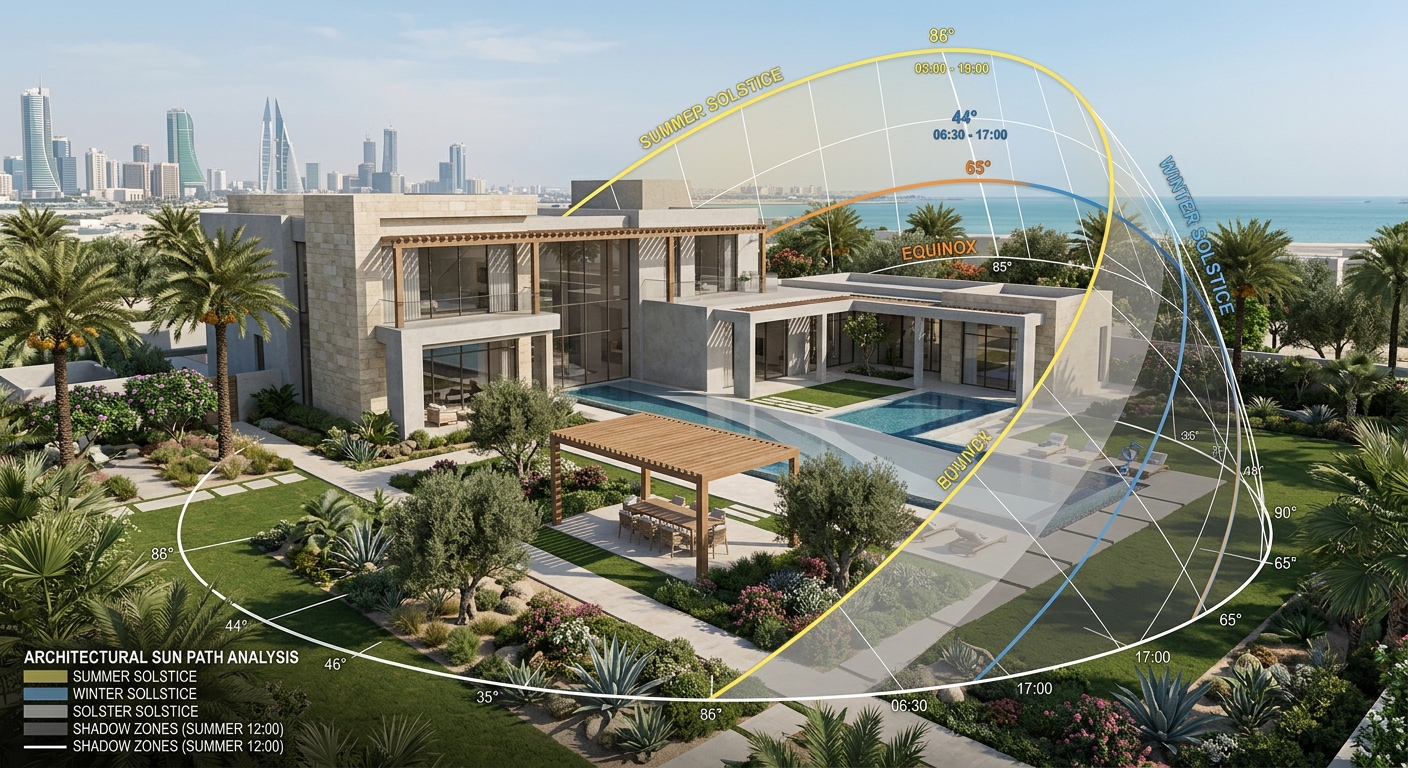
Phase 2: Sun-Path Mapping for Maximum Shade in July and August
Guessing where to put a pergola based on where it looks nice usually results in a seating area that is completely exposed to the sun when you actually want to use it. Landscape architects use 3D modeling software to track the exact shadow cast by your villa and boundary walls throughout the year.
This data dictates the exact height, angle, and louver spacing of your pergolas. It ensures your outdoor dining table is fully shaded by 1:00 PM in June, rather than relying on ineffective umbrellas that blow over in the shamal winds.
Phase 3: Sourcing Heat-Resistant Hardscaping and Local Stone
A common mistake is selecting dark porcelain tiles or cheap concrete pavers that absorb heat, reaching surface temperatures of 65°C by midday. This traps heat in the garden overnight and makes the surfaces impossible to walk on barefoot.
Bespoke landscaping utilizes materials engineered for thermal performance, such as light-colored travertine or local limestone, which reflect heat and remain cool to the touch.
- The tradeoff: Natural thermal-resistant stone costs BD 15 to BD 25 per square meter, compared to BD 5 for basic ceramics.
- The consequence of ignoring this: You create a localized oven effect that forces your villa's AC units to work harder to cool the adjacent indoor rooms.
Common Misconceptions About Custom Outdoor Spaces
Homeowners often make poor long-term decisions because they operate on outdated assumptions about what a high-end garden requires to survive in Bahrain.
The 'High Design Cost Equals High Water Usage' Myth
Many assume an intricately designed garden requires massive amounts of EWA water to maintain. In reality, poorly planned contractor gardens waste water through inefficient flood irrigation and uncalibrated timers that run during the heat of the day, losing 40% of their volume to evaporation.
An engineered landscape relies on pressure-compensated drip lines buried under mulch, delivering exact millimeter quantities directly to the root zones. This mechanism slashes water usage while keeping plants healthier, as it prevents the fungal diseases caused by spraying water directly onto leaves.

Assuming 'Bespoke' Requires High-Maintenance Imported Exotics
A false assumption is that custom gardens require delicate, imported European species that need constant chemical interventions to survive the Gulf climate. This approach guarantees high maintenance bills and inevitable plant death when a summer heatwave hits 48°C.
True bespoke landscaping uses hardy, climate-adapted species—like Bougainvillea, Plumeria, and Tecoma—but applies them structurally. Instead of a messy bush, a Bougainvillea is precisely espaliered against a boundary wall, providing high-end architectural impact with zero need for life-support systems.
Confusing a Planting Contractor with a Landscape Architect
Homeowners often try to save money by using a nursery or planting contractor who offers "free design" if you buy their plants. This usually results in a yard stuffed with whatever inventory the nursery needs to clear out, with zero consideration for drainage, electrical loads, or spatial flow.
Paying a landscape architect BD 1,000 to BD 2,500 for a design package buys you technical blueprints: grading plans to prevent flooding, lighting schematics, and structural details for pergolas. You give up the illusion of a "free" design to avoid the reality of ripping up your patio in two years to fix a broken, inaccessible irrigation pipe.
Why This Matters: The Financial and Practical Implications
Investing in a custom outdoor space is a capital allocation decision. It directly impacts your monthly operating costs, your property's market value, and your family's quality of life.
Extending Usable Outdoor Time by 3 to 4 Months Annually
A standard Bahrain garden is largely abandoned from May through October. By integrating engineered shade, strategic cross-ventilation, and localized misting systems, you manipulate the immediate microclimate.
This drops the ambient temperature in your seating zones by up to 10°C. Practically, this extends your outdoor living season, allowing you to comfortably host dinners or let children play outside in late May, September, and October.
Slashing Summer EWA Bills Through Smart Drip Irrigation Systems
Standard lawn-heavy gardens can easily drive summer EWA water bills past BD 150 a month, pushing you into higher tariff brackets. Standard timers water blindly, even right after a rare winter rain or during extreme humidity when plants need less water.
Smart irrigation controllers connected to local weather data adjust watering times automatically based on daily evapotranspiration rates. This precision typically cuts landscape water consumption by 50%, dropping a BD 150 bill down to BD 75, recovering the cost of the smart system within a single summer.
Adding 15-20% to Villa Resale Value in Neighborhoods Like Saar or Amwaj
When buyers tour villas in premium neighborhoods, a dead lawn or a cracked, heat-trapping patio immediately signals deferred maintenance. A mature, architecturally designed garden acts as a primary selling feature, effectively adding square footage to the usable living space.
Real estate data consistently shows that properties with engineered, low-maintenance landscapes sell faster and command a 15-20% premium. Buyers are willing to pay for the certainty that they won't inherit a massive EWA bill or a dying garden.
Real Examples of Bespoke Landscaping in Bahrain
Applying these principles looks different depending on the specific environmental constraints of your neighborhood.
The Amwaj Waterfront: Wind-Tolerant Planting and Salt-Spray Barriers
Villas on the water in Amwaj face constant, salt-heavy winds that burn the leaves of standard decorative plants. A bespoke landscaping approach here abandons delicate broadleaf plants entirely.
Instead, designers install structural glass windbreaks to protect seating areas without blocking sea views. Planting palettes shift to waxy-leafed, salt-tolerant species like Hibiscus tiliaceus or Carissa macrocarpa, which thrive in coastal spray while providing lush, dense screening from neighbors.

The Riffa Courtyard: Creating a Shaded, Private Family Oasis
In densely built areas of Riffa, the primary constraint is privacy from two-story neighboring windows overlooking the courtyard. Standard trees take a decade to grow tall enough to provide screening, leaving the family exposed.
The engineered solution involves planting mature, pleached trees—trees trained to grow on a flat, elevated trellis like a hedge on stilts. This instantly blocks sightlines from second-story neighbor windows while leaving the ground-level space open for a shaded outdoor majlis and dining area.
The Diyar Al Muharraq Compact Plot: Vertical Greening and Cooling Plunge Pools
Newer developments in Diyar Al Muharraq often feature compact 250sqm to 300sqm plots where every square meter counts. A traditional lawn and wide planting beds consume too much floor space, leaving no room for seating.
Custom designs here push the greenery to the perimeter using automated vertical living walls, drawing the eye upward and cooling the boundary walls. Small, mechanically chilled plunge pools are integrated flush with the patio, serving as a thermal mass to cool the ambient air without requiring the massive footprint of a traditional swimming pool.
Conclusion
The core insight of bespoke landscaping is that outdoor spaces in Bahrain require just as much engineering, infrastructure, and spatial planning as the interior of your villa. It is a calculated response to harsh sunlight, expensive municipal water, and the need for private family recreation.
Before hiring a contractor to blindly dig up your yard, evaluate your current EWA bills, track where the sun hits your plot at 2:00 PM, and clearly define how many months of the year you actually want to use the space. Your next step is to consult a landscape architect to audit your soil and water pressure—only then can you design an outdoor space that actually survives and performs.