Crafting Bespoke Gardens in Bahrain
You will design and install a custom, sustainable garden tailored to Bahrain’s extreme summer climate and high-salinity soil. Expect a 4 to 8-week timeline and a moderate-to-high difficulty level requiring coordination with local nurseries and hardscaping suppliers.
The most common reason homeowners fail when crafting bespoke gardens in Bahrain is attempting to replicate water-heavy European designs. These layouts inevitably wither by July while driving Electricity and Water Authority (EWA) bills to unsustainable levels. This method succeeds by prioritizing deep soil amendment, automated sub-surface irrigation, and the strategic layering of climate-adapted flora.
What You Need Before Starting: Permits, Budget, and Baseline Materials
Establish the legal, financial, and environmental prerequisites required before breaking ground on a residential plot. Skipping this phase guarantees costly tear-downs or dead plants within the first six months.
Securing Ministry of Works and Municipality Approvals for Hardscaping
Before pouring concrete or building boundary walls, verify your property lines and utility corridors. If you build a pergola footprint or concrete planter over a buried EWA water main or Batelco fiber line, the municipality will force you to demolish it at your own expense. Obtain a No Objection Certificate (NOC) from the Ministry of Works if your landscaping touches the exterior pavement or alters street drainage.
Allocating a BD 3,000 to BD 10,000+ Budget for Premium Materials
A sustainable garden requires heavy upfront investment in infrastructure rather than just expensive plants. Allocate your budget using this baseline distribution:
- 30% for Soil and Prep: Excavation, disposal of bad soil, and importing premium agricultural soil.
- 30% for Irrigation and Flora: Wi-Fi controllers, pressure-compensating piping, and mature tree specimens.
- 40% for Hardscaping: Paving, shade structures, and lighting.
Attempting to cut costs by keeping the existing developer soil will result in a 100% plant mortality rate by the end of your first summer.
Mapping Your Villa's August Sun Traps and Shamal Wind Corridors
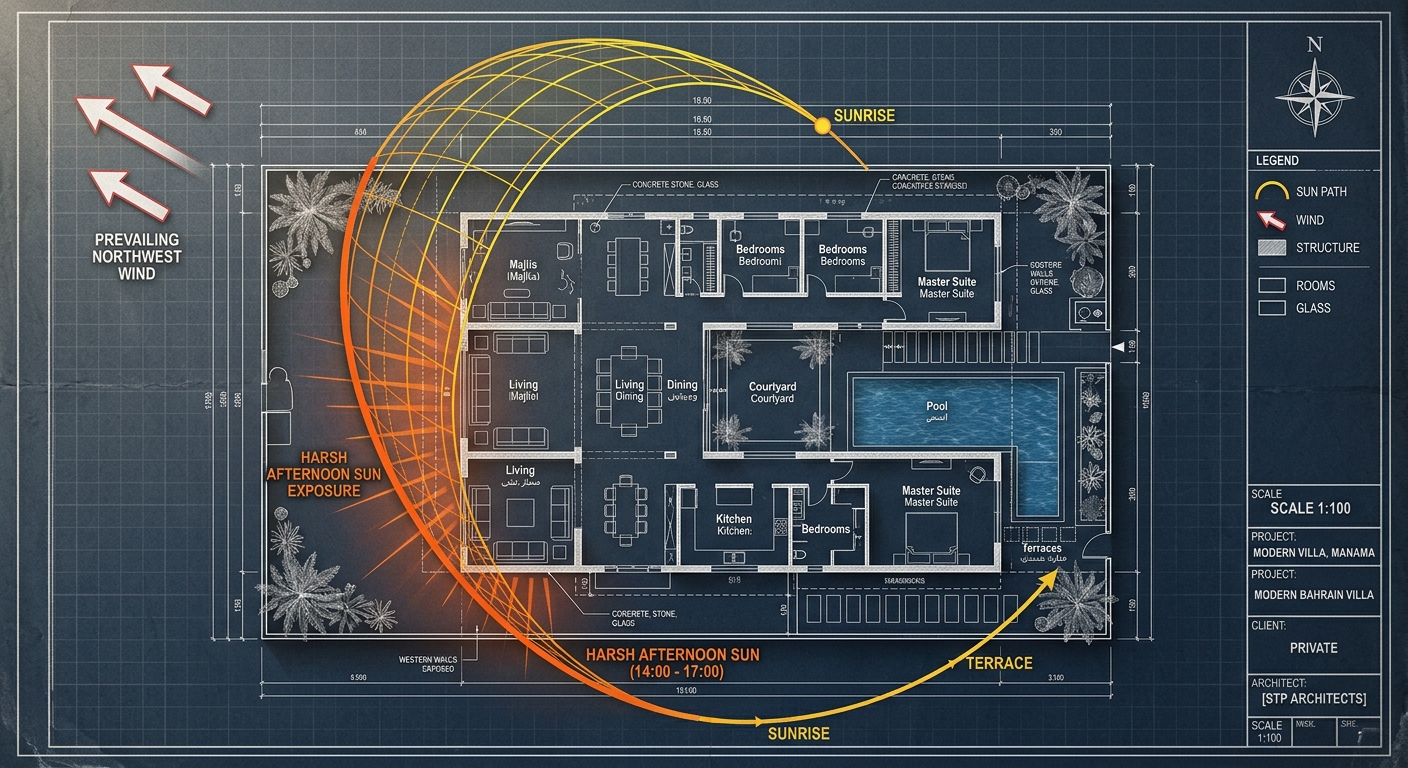
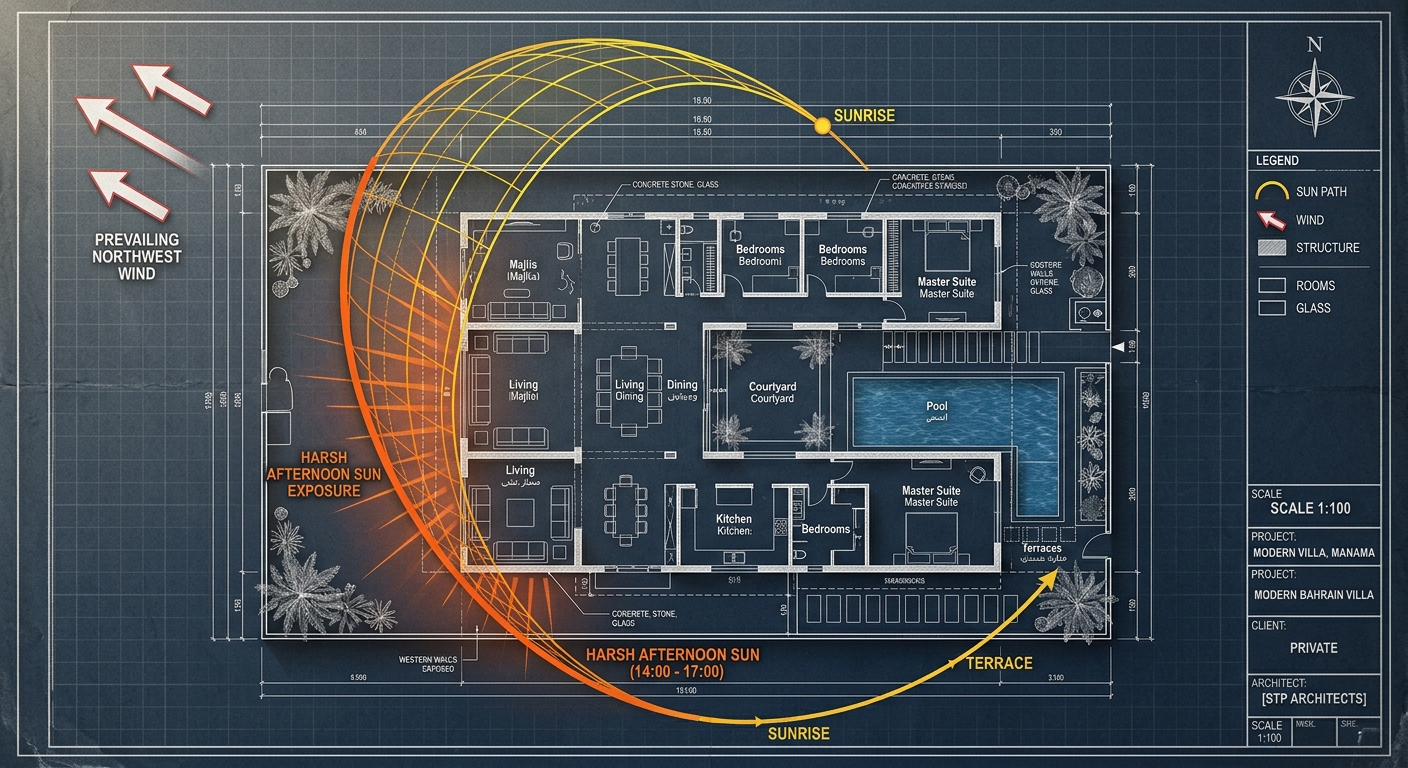
Track where the sun hits your yard between 12:00 PM and 4:00 PM during peak summer. South and west-facing walls act as thermal batteries, absorbing heat and baking adjacent plants overnight. Map the north-western corridors where the hot, dusty Shamal winds channel through your property, as these areas require hardy windbreak trees rather than delicate ornamentals.
Step 1: Excavate and Rebuild the Soil Profile
Remove the nutrient-poor, highly saline sand left by developers and replace it with a foundation capable of retaining moisture and sustaining plant life.
Warning: Before digging, locate all underground EWA electrical cables and water pipes using your villa's as-built drawings. Severing a main line is an expensive and dangerous mistake.
Excavating 30cm to 50cm of Saline Builder's Sand
Hire a local contractor to excavate the top 30cm of soil from lawn areas and 50cm from planting beds. The native dirt left by construction crews in Bahrain is highly alkaline (pH 8.0+) and saturated with construction debris and salt. Haul this dead sand off-site. You should see a uniform, level trench across all future planting zones.
Layering Agricultural Sweet Soil and Commercial Organic Compost
Fill the excavated areas with a 70:30 mix of local "sweet soil" (desalinated agricultural topsoil) and commercial organic compost. Distribute the soil evenly using a landscaping rake. This ratio provides the necessary weight to anchor roots while introducing the microbial life required for nutrient uptake.
Adding Perlite and Peat Moss to Improve Water Retention
Till 20 liters of perlite and 10 liters of peat moss into every square meter of the new topsoil. Work the amendments into the top 15cm of the soil profile using a mechanical rototiller.
- Outcome: Grab a handful of the finished soil and squeeze it. It should form a loose ball that holds its shape but crumbles easily when poked. If it forms a hard clay lump, add more perlite. If it slips through your fingers, add more compost.
Step 2: Install an Automated Drip Irrigation Network
Set up a water-efficient delivery system that minimizes evaporation and prevents exorbitant utility costs. Crafting bespoke gardens in Bahrain requires treating water as a premium commodity.
Routing Sub-Surface Drip Lines Directly to Root Zones
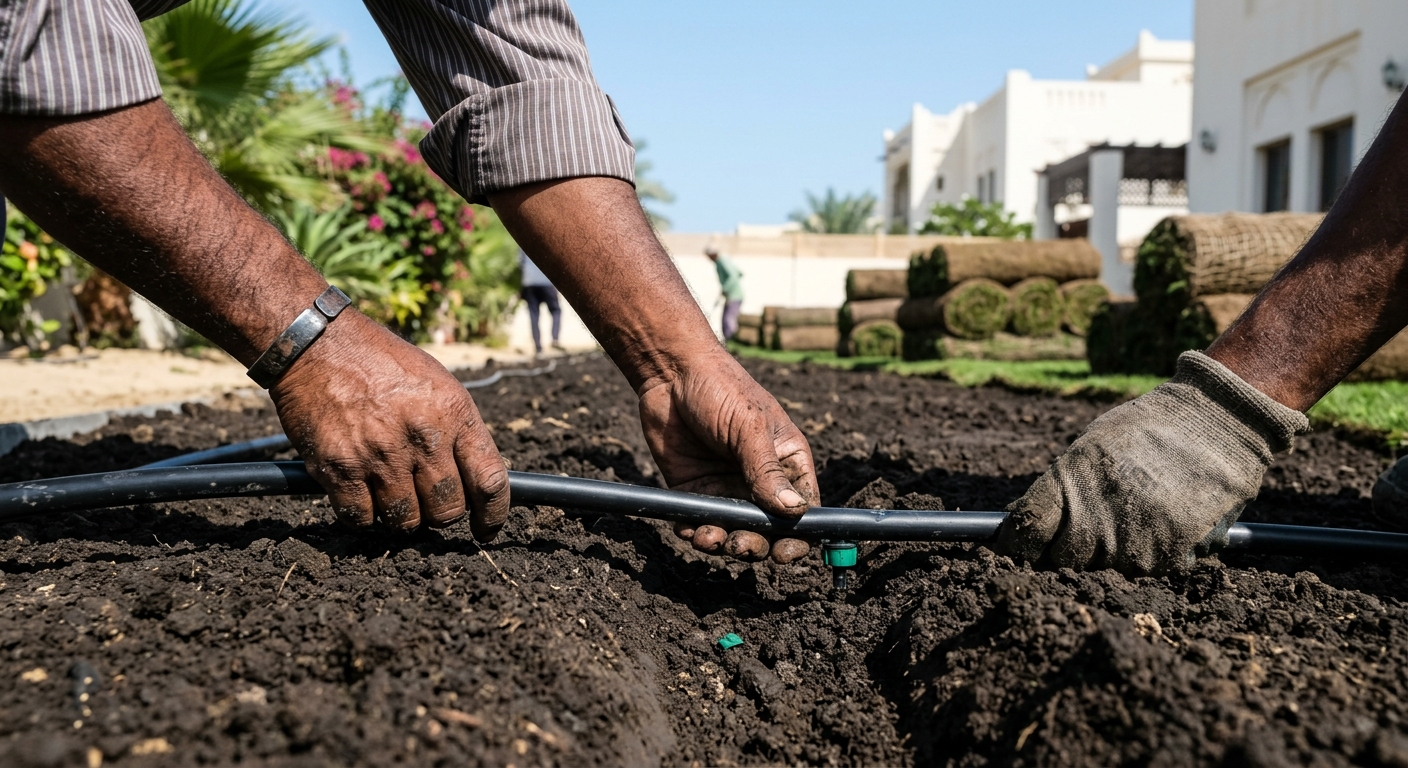
Lay 16mm polyethylene drip tubing in a grid pattern across your planting beds, burying the lines 10cm below the soil surface. Space the lines 30cm apart for dense groundcover or loop them directly around the root balls of larger shrubs. You should see a neat, interconnected grid of black tubing before covering it with the final layer of mulch or soil.
Installing Pressure-Compensating Emitters to Handle EWA Pressure Variations
Punch holes into the drip line and insert pressure-compensating (PC) emitters rated for 4 to 8 liters per hour at every plant base. Bahrain's municipal water pressure fluctuates wildly depending on the neighborhood and time of day.
- Why this matters: Standard emitters will flood the first plant on the line and starve the last one. PC emitters ensure every plant receives the exact same volume of water regardless of pressure drops.
Calibrating Wi-Fi Enabled Smart Controllers
Wire the irrigation valves to a smart controller (like a Rachio or Hunter Hydrawise) and connect it to your home Wi-Fi. Program a split schedule for summer: 15 minutes at 4:30 AM and 10 minutes at 6:30 PM.
- Outcome: Turn the system on manually for a 10-minute test. Dig 5cm down near an emitter. The soil should feel dark and damp, but water should not be pooling on the surface. If water pools, reduce the run time.
Step 3: Anchor the Design with Climate-Adapted Flora
Select and position structural trees and shrubs that thrive in 45°C+ temperatures and high August humidity.
Positioning Date Palms and Neem Trees to Generate Canopy Shade
Plant mature Date Palms or Neem trees along the western and southern boundaries of your garden. Time estimate: Expect this step to take 4 to 6 hours per tree, requiring a small crane for positioning. These species tolerate saline soil and create a natural cooling canopy that reduces ground temperatures by up to 10°C, creating micro-climates for sensitive plants below.
Layering Plumeria, Bougainvillea, and Desert Rose for Color
Dig holes twice the width of the nursery pots and plant your mid-tier shrubs within the newly established shade zones. Use Bougainvillea for climbing walls, Plumeria (Frangipani) for fragrant corner accents, and Desert Rose (Adenium) for low-water focal points.
- Outcome: Water them heavily immediately after planting. After two weeks, tug gently on the base of the shrubs. You should feel resistance, indicating the roots are successfully anchoring into the sweet soil.
Selecting Paspalum Turf or Premium Artificial Grass for the Lawn Area
Choose your ground cover based on your maintenance tolerance and budget.
- Paspalum Turf: A salt-tolerant real grass that thrives in Bahrain. It cools the surrounding air but requires mowing every 10 days and will add BD 20 to BD 40 to your summer EWA bill.
- Premium Artificial Grass: Requires zero water and stays green year-round. However, it acts as a thermal heat sink, routinely reaching 70°C in direct August sun, making it unusable for bare feet or pets during the day.
Step 4: Construct Heat-Resistant Hardscaping and Shade Structures
Integrate non-living elements that make the garden usable year-round without turning into thermal ovens.
Selecting Low-Thermal-Mass Paving Stones Over Dark Concrete
Lay light-colored travertine, limestone, or exterior-grade porcelain pavers for your walkways and patios. Never use dark stamped concrete or black asphalt in a Bahraini garden. Dark materials absorb intense solar radiation during the day and release it at night, effectively baking your surrounding plants and increasing your villa's cooling costs.
Erecting UV-Treated Pergolas and Sail Shades
Bolt aluminum pergolas or tensioned High-Density Polyethylene (HDPE) sail shades over seating areas and sensitive plant zones. Ensure the fabric is explicitly rated for 95%+ UV blockage.
- Outcome: Walk barefoot on your paving stones under the shade structure at 1:00 PM. The stones should feel warm but should not burn your feet. If they burn, your shade material lacks adequate UV density.
Incorporating Circulating Water Features for Localized Cooling
Install a self-contained water feature, such as a stone fountain or a modern spillway, positioned upwind of your seating area. Connect it to a dedicated auto-fill valve tied to your main water line. As the Shamal winds blow across the moving water, it creates a localized evaporative cooling effect, dropping the ambient temperature in your seating area.
Common Mistakes That Cause Failure: Why Bahrain Gardens Wither
Identify the critical errors in timing, plant selection, and maintenance that destroy newly installed landscapes.
Installing Flora During the May-to-September Heatwave
Never plant new trees or shrubs between May and September. Nursery plants raised under shade cloths will go into immediate, irreversible heat shock when transferred to open ground in 40°C+ heat. Always schedule your planting phase between late October and early March.
Ignoring Hard-Water Calcium Buildup in Irrigation Emitters
Bahrain's municipal water contains high levels of calcium and dissolved minerals. Over time, this calcification clogs the tiny holes in your drip emitters. If you ignore this, plants will slowly die of thirst even while your irrigation controller runs perfectly.
Relying on Overhead Sprinklers
Do not install pop-up overhead sprinklers for anything other than dense turf. Spraying water through the air in Bahrain results in up to 40% moisture loss due to immediate evaporation. Furthermore, water droplets resting on plant leaves act as magnifying glasses under the harsh sun, causing severe foliar burns.
How to Know It Worked: 90-Day Verification and Stress Tests
Evaluate the health of your garden and the efficiency of your systems during the critical establishment phase.
Measuring Soil Moisture Retention at 15cm Depth
Insert a digital soil moisture probe 15cm into the dirt near the base of a newly planted tree at 2:00 PM, ideally mid-summer.
- Expected Outcome: The meter should read in the "moist" range (typically a 4 to 6 on a 10-point scale). If it reads bone dry, your soil lacks peat moss or your irrigation run-time is too short.
Auditing Your First Post-Installation EWA Water Bill
Check your first monthly EWA bill after the new planting. A temporary spike of BD 15 to BD 25 is expected as plants require extra establishment watering.
- Failure condition: If your water bill spikes by BD 50 or more, shut off the main irrigation valve immediately. You have an underground leak in your PVC mains or a severed drip line that needs immediate repair.
Observing Robust New Leaf Growth During the October Climate Transition
Inspect the branch tips of your Bougainvillea and Plumeria in late October when nighttime temperatures finally drop below 30°C. You should see clusters of bright green, pliable new leaf nodes emerging. This visual cue proves the root systems survived the summer stress and are actively utilizing the amended soil nutrients.
Conclusion
Crafting bespoke gardens in Bahrain requires replacing saline developer soil, installing evaporation-proof sub-surface irrigation, and selecting hard-wearing native or adapted plants. If your plants show signs of severe heat stress (crispy, yellowing leaf edges) despite automated watering, check your emitters for calcium blockages first. If the emitter flows freely, the plant requires temporary intervention; deploy a 50% agricultural shade cloth over the stressed plant until temperatures drop in October.
Once your garden survives its first full summer, your next step is to establish a quarterly maintenance schedule with a local landscaping firm. Have them handle seasonal deep-pruning in February and apply slow-release granular fertilizers in November to maintain the structural integrity of your bespoke landscape.